01
10 2026
What Are the Differences Between Condenser Units?
Condenser units are undoubtedly among the most critical components of industrial and commercial refrigeration systems. These units, which facilitate the condensation of the high-pressure, hot gas discharged from the compressor—the heart of the refrigeration cycle—directly impact system efficiency. In refrigeration solutions and engineering design, selecting the right condenser is vital for energy savings and facility safety.
So, what are the key differences between the various condenser units available on the market? Which type of condenser is best suited for your business or project? In this article, we examine the different types of condenser units and the distinctions between them in detail.
What Is a Condenser Unit and What Does It Do?
In refrigeration systems, the refrigerant compressed by the compressor reaches high temperatures and pressures. The condenser unit enables the heat within this fluid to be rejected to the external environment, causing the fluid to condense and transition into a liquid phase. Efficient heat transfer is a primary requirement for maintaining cooling capacity and the system's operational lifespan.
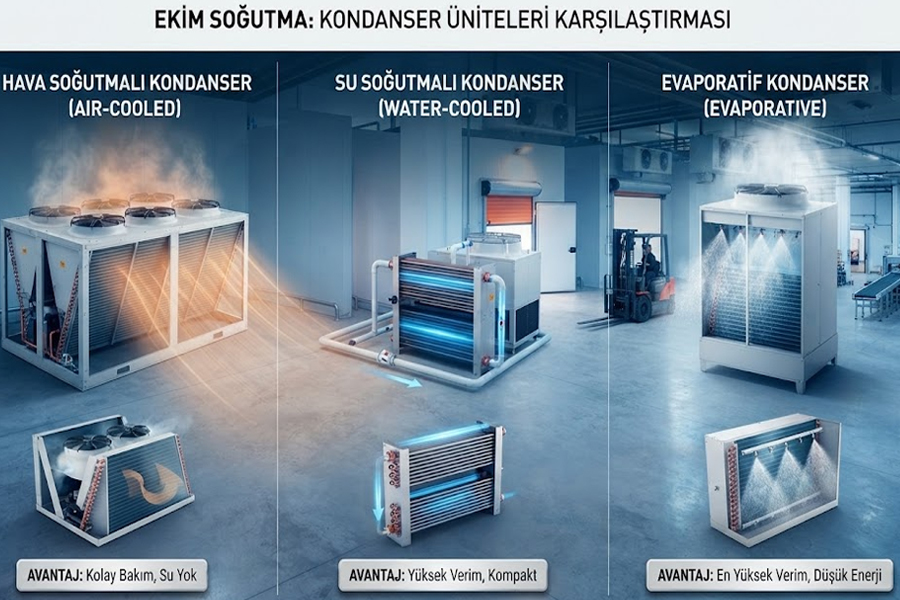
Condensers are primarily categorized into three groups based on the cooling medium (fluid type): air-cooled, water-cooled, and evaporative condensers. Each system differs in terms of its operating principle, advantages, and disadvantages. Key Differences Between Condenser Units
1. Air-Cooled Condenser Units
As the name implies, air-cooled units reject heat to the external environment by blowing air—using fans—across copper tubes and aluminum fins.
Advantages: Installation and maintenance are extremely easy. They do not require an additional water supply or water treatment system. They are ideal for small and medium-sized businesses.
Disadvantages: Condensing temperatures can rise during summer months when ambient temperatures are excessively high, potentially increasing energy consumption. They may require significant space.
Applications: Supermarkets, small cold storage facilities, commercial refrigeration cabinets, and hotels.
2. Water-Cooled Condenser Units
In water-cooled systems, heat from the refrigerant is transferred to water via a heat exchanger (shell-and-tube or plate type). The heated water is typically sent to a cooling tower to be cooled down again.
Advantages: They are minimally affected by ambient air temperatures. They operate with greater stability and higher efficiency in high-capacity systems. Thanks to their compact design, they occupy less space.
Disadvantages: They require a continuous water supply. Failure to monitor water quality poses a risk of scaling and corrosion, which increases regular maintenance costs.
Applications: Large industrial facilities, large cold storage warehouses, central air conditioning systems, and ice manufacturing plants. 3. Evaporative Condenser Units
These systems combine the power of air and water. They utilize the latent heat of vaporization by spraying water over the coil while simultaneously generating airflow with fans.
Advantages: They offer top-tier performance in terms of energy efficiency. By operating at lower condensing temperatures, they significantly reduce compressor electricity consumption.
Disadvantages: They have high initial investment costs and require regular water and chemical maintenance.
Which Condenser Should You Choose for Your Business?
When selecting the right condenser unit, factors such as geographical location, average ambient temperatures, water supply availability, space constraints, and the operating budget must be considered. While water-cooled or evaporative systems are preferred for hot climates and high-capacity projects, air-cooled systems are often chosen for standard commercial applications due to their practicality.
You can contact our expert engineering team for professional guidance on condenser units that meet cooling standards, precisely match your project's load calculations, and deliver maximum long-term energy savings.